Postpartum Coaching or Therapy: Which One Do I Need?
Support · Getting Started
Postpartum Coaching or Therapy: Which One Do I Need?
Both kinds of support are real support. The question is which one fits this season.
One of the questions I hear most often, usually in a small voice at the end of a consultation, is some version of this: "I don't know if I need a coach or a therapist. I just know I'm not okay." If that is where you are, you are in the right place, and you do not have to figure it out alone.
I want to start by saying something that took me a long time to believe for myself. Needing help after a baby is not a sign that you are doing it wrong. I am a licensed clinical social worker and a mom of five, and I still remember sitting on the edge of my bed with my first baby, wondering why everyone else seemed to know what they were doing. Nobody handed me a map. Most parents don't get one.
At Marésel Grace, we offer both coaching and therapy, which means I get to see up close how different they are and how often parents need a little of each. This post is my attempt to give you the map I wish I'd had.
What Coaching Is
Coaching is practical, forward-looking support. It is for the ordinary-but-hard parts of pregnancy and new parenthood: the identity shift, the exhaustion, the tension with your partner over who does the 2am feed, the guilt about going back to work (or about not going back).
A coach helps you get clear on what you want, notice what is getting in the way, and take small, doable steps. Sessions tend to feel like a focused conversation with someone who is fully on your side. You might leave with a plan for the next week, a script for a hard conversation, or simply the relief of having said something out loud that you have been carrying for months.
Coaching does not diagnose or treat mental health conditions. That is a feature. Plenty of parents are not facing a clinical condition at all. They are tired, stretched and a little lost, and what they need is structure, encouragement and someone to think with.
Coaching is often a good fit if you:
- Feel overwhelmed but are still sleeping when you get the chance, eating and getting through your days
- Want help with a specific area, like routines, returning to work, boundaries with family or dividing the load at home
- Feel like you have lost track of who you are outside of being a parent
- Want support that fits around naps and feedings, by phone or video, from anywhere in the US
What Therapy Is
Therapy is clinical care. A licensed therapist can assess what is going on, diagnose conditions like postpartum depression, anxiety or OCD, and use treatment approaches built for those conditions. Therapy also makes room for the deeper layers: past trauma, a hard birth, grief, or old family patterns that suddenly feel very loud now that you are a parent yourself.
Therapy can be practical too. People sometimes picture lying on a couch talking about their childhood for years. Good perinatal therapy is often warm, active and focused on helping you feel better in your real life, fairly quickly.
Therapy is often a better fit if you:
- Have felt sad, numb, hopeless or on edge most days for more than two weeks
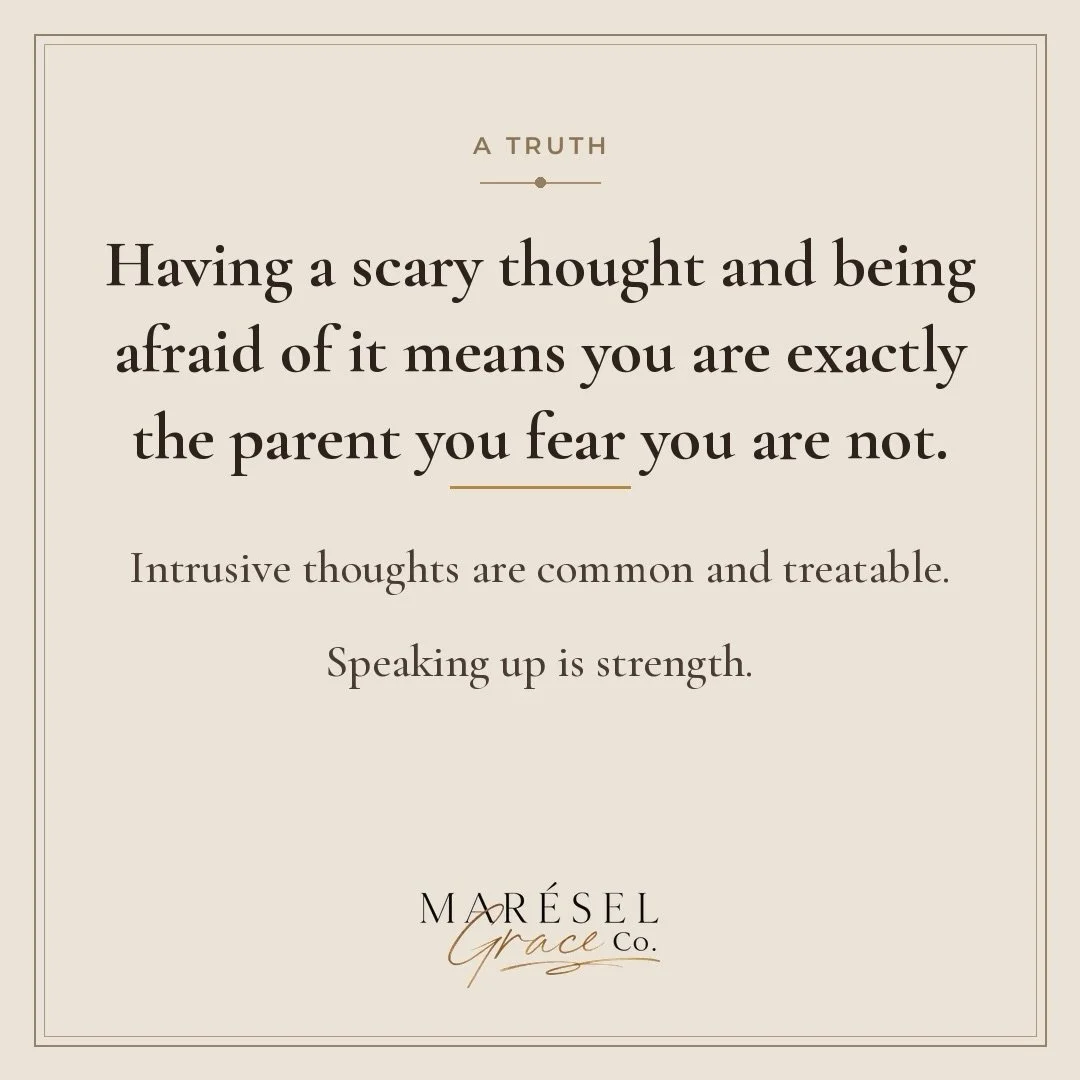
- Are having intrusive thoughts that scare you, or rituals you feel you have to do to stay calm
- Can't sleep even when the baby is sleeping
- Have a history of depression, anxiety or trauma that feels stirred up
- Are finding it hard to function, bond with your baby or enjoy anything at all
At Marésel Grace, therapy is available with me, as a licensed clinician, for anyone living in Massachusetts, in person in Harvard or by secure video.
The Gray Area Most Parents Live In
Here is the part the charts and checklists usually miss. Most parents do not fall neatly into one box.
You might be mostly okay but have a few rough evenings a week where the sadness hits hard. You might be functioning fine at work and then crying in the car in the daycare parking lot. You might not be sure whether what you feel is "normal new parent stuff" or something more.
That uncertainty is exactly why we start every new client with a consultation. It is a short conversation where we talk about what is going on, what you have tried, and what you are hoping for. From there, we can suggest a starting point. Sometimes that is coaching. Sometimes it is therapy. Sometimes it is coaching now, with the door open to therapy later if things shift.
I think of it a little like a staircase. Coaching is often the first step, because it meets you early, before things fall apart. If you need more, you can take the next step up without starting over with a stranger somewhere new.
A Few Questions to Ask Yourself
If you are trying to sort out which kind of support fits, sit with these questions for a minute. There are no right answers. They are only meant to help you notice.
- When I picture feeling better, what does that look like? Is it mostly about practical changes, or about the heaviness lifting?
- How long have I felt this way? A few rough weeks, or most days for a month or more?
- Am I still able to do the basics, like eating, showering and caring for my baby, even if it is hard?
- Do my feelings scare me, or do I mostly feel frustrated and stuck?
- Have I felt this way before, before the baby?
If your answers lean toward "the heaviness," "a long time," "it's hard to function" or "it scares me," therapy is probably the better first step. If they lean toward "practical changes" and "stuck," coaching may be exactly what you need.
When you need help right away
If you are having thoughts of harming yourself or your baby, if you feel confused or out of touch with reality, or if you have not slept in days, please do not wait for a consultation. Call or text 988, call the National Maternal Mental Health Hotline at 1-833-852-6262, or call 911. These feelings are treatable, and reaching out quickly is the strongest thing you can do.
What a First Session Looks Like
A lot of parents put off reaching out because they don't know what will happen once they do. So here is what to expect.
A first coaching session usually starts with your story. What does a typical day look like right now? What feels heaviest? What would "a little better" look like a month from now? By the end, we usually have one or two small things to try before the next session. Small is the point. When you are running on four hours of sleep, a ten-step plan is just one more thing to fail at.
A first therapy session is a little more structured. I will ask about your mood, sleep, appetite, your pregnancy and birth, your history and your support system. Some of those questions can feel personal. You are always allowed to say "I'm not ready to talk about that yet." We go at your pace.
In both, your baby is welcome. I have held many babies during sessions, and I have watched plenty of parents nurse, bounce or rock their way through a hard conversation. You do not need to find childcare to get care.
What About Cost and Insurance?
This is a real question, and it deserves a straight answer. Coaching is non-clinical, so it is not billed through insurance. Our therapy is out of network, which means we don't bill insurance directly. Everything is self-pay, and prices are listed for each service so you know exactly what to expect.
I know that can feel like a lot, especially on one income or with a new baby's expenses piling up. A few things that may help: some parents use a health savings or flexible spending account for therapy, and some start with a single consultation to get clear before committing to anything. If cost is the main barrier, please tell us. We would rather help you find the right resource, even if it is not us, than have you go without support.
What Parents Often Tell Me After They Start
The most common thing I hear, a few sessions in, is "I wish I'd done this sooner." Parents tell me they waited because they thought they were not struggling "enough." They thought help was for people who were falling apart.
It isn't. Support works best when it comes early. A coaching session in month two can keep a hard season from turning into a crisis in month six. Therapy that starts when symptoms first show up usually works faster than therapy that starts after a year of white-knuckling.
The second most common thing I hear is relief at not having to choose perfectly. You do not have to diagnose yourself before you reach out. That is our job. Your only job is to say, "I'm not okay, and I'd like some help."
Coaching and Therapy Can Work Together
Some parents do both at once. A mom working with me in therapy on anxiety and a traumatic birth might also work with one of our coaches on returning to work or building a routine that leaves room for rest. A dad might start with coaching to figure out how to show up for his partner, then realize he has his own grief to work through.
When everything lives under one roof, those pieces can talk to each other (with your permission). That was one of the biggest reasons I built Marésel Grace the way I did. I watched too many parents get bounced between referrals, telling their story again and again, and giving up somewhere along the way.
If You Are Still Not Sure
Here is what I'd suggest. If you are reading this and you are not sure, book a consultation. It is low pressure. We will listen, ask a few questions, and suggest where to start. If we are not the right fit, we will say so and help you find someone who is.
You are not too much. You are not too late. You do not have to be falling apart to deserve support.
Not Sure Where to Start? Let's Figure It Out Together.
Book a consultation and we will help you decide between coaching and therapy, with no pressure and no wrong answers. Kids are always welcome.
Book a Consultation